
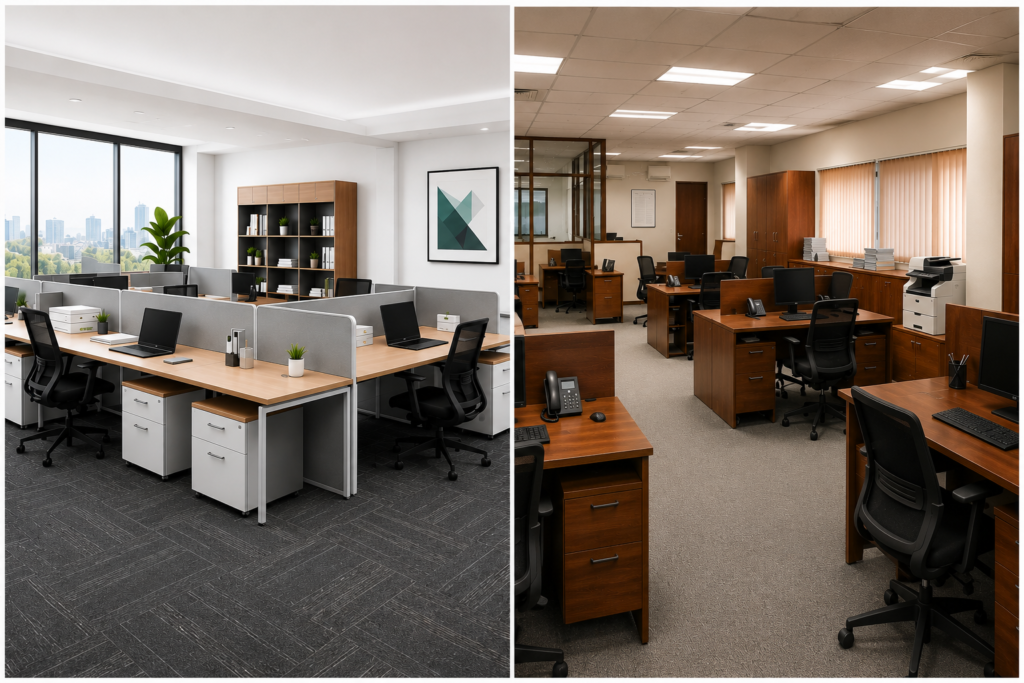
Modular vs Traditional Office Furniture: Which Is Better for Your Business?
Content Outline
- Introduction
- What is Modular Office Furniture?
- What is Traditional Office Furniture?
- Modular vs Traditional Office Furniture: Side-by-Side Comparison
- Advantages of Modular Office Furniture
- Advantages of Traditional Office Furniture
- Which Furniture is More Cost-Effective?
- Which Option is Better for Growing Businesses?
- When Should You Choose Traditional Furniture?
- Our Recommendation
- Frequently Asked Questions
- Conclusion
Modular vs Traditional Office Furniture: Which Is Better for Your Business?
Choosing office furniture is more than selecting desks and chairs. The right furniture affects productivity, employee comfort, collaboration, maintenance costs, and even your company’s ability to grow.
One of the most common questions businesses ask is:
Should we invest in modular office furniture or stick with traditional office furniture?
The answer depends on your workspace, budget, expansion plans, and working style.
This guide compares both options to help you make an informed decision.
What is Modular Office Furniture?
Modular office furniture consists of standardized components that can be assembled, rearranged, expanded, or reconfigured as business needs change.
Common modular office furniture includes:
- Modular workstations
- Executive desks
- Manager cabins
- Conference tables
- Reception desks
- Office partitions
- Storage cabinets
- Mobile pedestal units
- Collaborative furniture
- Training room furniture
Instead of building furniture permanently into the office, modular systems are designed for flexibility and future modifications.
What is Traditional Office Furniture?
Traditional office furniture generally refers to fixed furniture that is custom-built or permanently installed.
Examples include:
- Heavy wooden executive tables
- Built-in storage units
- Fixed cabins
- Permanent conference tables
- Custom carpentry furniture
These pieces are usually difficult to relocate or modify after installation.
Traditional furniture often focuses on aesthetics and permanence rather than flexibility.
Modular vs Traditional Office Furniture: Comparison
| Feature | Modular Office Furniture | Traditional Office Furniture |
|---|---|---|
| Flexibility | Excellent | Limited |
| Customization | High | Moderate |
| Expansion | Easy | Difficult |
| Installation | Fast | Time-consuming |
| Relocation | Easy | Challenging |
| Maintenance | Simple | More difficult |
| Replacement | Individual components can be replaced | Often requires replacing the complete unit |
| Workspace Optimization | Excellent | Limited |
| Initial Cost | Moderate | Can be higher depending on materials |
| Long-Term Value | High | Moderate |
Design Flexibility
Modern businesses rarely stay the same for years.
Teams grow.
Departments shift.
New technologies require different layouts.
Hybrid working models continue to evolve.
Modular office furniture allows businesses to adapt without replacing the entire office setup.
You can:
- Add more workstations
- Expand departments
- Create collaboration zones
- Convert open spaces into cabins
- Rearrange seating layouts
Traditional furniture offers much less flexibility once installed.
Winner: Modular Office Furniture
Installation Time
Traditional carpentry often requires:
- On-site fabrication
- Wood polishing
- Finishing work
- Extended installation time
This may disrupt daily business operations.
Modular furniture is manufactured in advance and assembled on-site.
As a result:
- Installation is faster
- Offices become operational sooner
- Minimal disruption occurs during setup
Winner: Modular Office Furniture
Scalability
A startup with 15 employees may become a company of 60 employees within a few years.
Replacing all furniture every time the team expands isn’t practical.
Modular furniture systems are designed to grow with your business.
Additional desks, partitions, storage units, and accessories can often be integrated into the existing layout.
Traditional furniture usually requires extensive modifications or complete replacement.
Winner: Modular Office Furniture
Space Utilization
Efficient use of office space directly impacts productivity and operational costs.
Modular office furniture is designed with workspace planning in mind.
It can include:
- Integrated cable management
- Compact storage
- Shared workstations
- Collaborative seating
- Multi-functional furniture
- Flexible partitions
Traditional furniture often occupies more space and offers fewer layout options.
Winner: Modular Office Furniture
Maintenance and Repairs
Furniture experiences daily wear and tear.
With modular furniture:
- Damaged panels can be replaced
- Accessories can be upgraded
- Individual components can be repaired
There’s no need to replace the complete workstation.
Traditional furniture often requires extensive repairs or complete replacement.
This increases maintenance costs over time.
Winner: Modular Office Furniture
Appearance and Professional Image
Both furniture styles can create attractive offices.
Traditional furniture offers:
- Rich wooden finishes
- Classic executive appearance
- Premium handcrafted detailing
Modular furniture offers:
- Contemporary aesthetics
- Minimalist designs
- Uniform appearance
- Better cable management
- Modern finishes
- Cleaner workspace organization
For most modern offices, modular furniture aligns better with today’s workplace expectations.
Winner: Depends on your office style.
Cost Comparison
Many businesses assume modular furniture is expensive.
However, total ownership cost often tells a different story.
Traditional Furniture Costs
- Higher installation time
- Difficult relocation
- Expensive modifications
- Costly repairs
- Limited reuse
Modular Furniture Costs
- Faster installation
- Easier maintenance
- Reusable components
- Lower upgrade costs
- Better long-term value
Although the initial investment may be similar in many cases, modular office furniture generally provides a better return over its lifecycle.
Sustainability
Businesses increasingly prioritize environmentally responsible workplaces.
Modular furniture supports sustainability by:
- Reducing material waste
- Allowing component replacement instead of full replacement
- Extending product life
- Supporting office reconfiguration without new furniture purchases
Traditional furniture may generate more waste during renovation or office expansion.
Which Businesses Should Choose Modular Office Furniture?
Modular furniture is ideal for:
- Startups
- IT companies
- Corporate offices
- Educational institutions
- Co-working spaces
- Healthcare facilities
- Manufacturing offices
- Government organizations
- Expanding businesses
- Multi-location companies
Any organization expecting future growth benefits from a modular approach.
When Traditional Office Furniture Makes Sense
Traditional furniture may still be suitable for:
- Executive cabins with premium handcrafted interiors
- Heritage offices
- Luxury boardrooms
- Boutique consulting firms
- Spaces where the layout is unlikely to change for many years
Even in these environments, many businesses combine traditional aesthetics with modular functionality for the best of both worlds.
Our Recommendation
For most businesses today, modular office furniture is the more practical and future-ready choice.
It offers:
- Greater flexibility
- Faster installation
- Easier maintenance
- Better scalability
- Efficient space utilization
- Lower lifecycle costs
- Professional appearance
- Adaptability for changing work environments
Traditional furniture still has its place in select applications, but businesses seeking long-term efficiency, growth, and workplace flexibility will generally benefit more from modular solutions.
Frequently Asked Questions
Is modular office furniture more durable than traditional furniture?
High-quality modular office furniture is designed for commercial use and can be highly durable. Durability depends on factors such as materials, manufacturing quality, hardware, and proper installation rather than the furniture style alone.
Is modular furniture suitable for small offices?
Yes. Modular furniture is especially effective in small offices because it maximizes available space while allowing future expansion without major renovations.
Can modular office furniture be customized?
Yes. Businesses can customize dimensions, finishes, colors, storage options, partition heights, cable management, and layouts to match their workspace requirements and brand identity.
Is modular furniture easy to relocate?
Yes. Most modular furniture systems can be dismantled, transported, and reassembled with significantly less effort than fixed traditional furniture.
Which is more economical in the long run?
For most organizations, modular office furniture offers better long-term value because it reduces maintenance costs, supports future expansion, and allows individual components to be replaced instead of entire furniture units.
Conclusion
The choice between modular and traditional office furniture depends on your business goals, workspace requirements, and future plans. Traditional furniture can provide a timeless, premium appearance for fixed spaces, while modular furniture offers the flexibility, scalability, and efficiency that modern workplaces increasingly require.
If your organization expects growth, values efficient space planning, or wants furniture that can adapt to changing teams and layouts, modular office furniture is generally the stronger long-term investment.